Malicious programs, or as they are called in the Kaspersky Laboratory - malware, can cause serious damage to a computer by deleting, distorting, mass copying, and hiding information stored on the computer.
Such software is commonly called "Viruses," and it is divided into classes, meaning viruses can be grouped into categories (classes). It is generally believed that the main goal of malicious software (malware) is unauthorized access to information stored on a computer, bypassing OS access restrictions.
These programs are created by specialists called Hackers.
Hacker is a professional programmer who knows the OS architecture inside and out, how it works with memory, how protocols, drivers, devices, and much more communicate with each other.
All this allows them to create malicious programs that bypass computer protection to cause harm, steal files, or do other damage.
As a rule, protecting against viruses is not difficult; it is enough to follow generally accepted rules, and the chance of infecting a computer with a virus will significantly decrease. The first and perhaps most important condition for protecting a computer from viruses is timely updating of the OS. Currently, the safest OS in the Windows family is Windows 8, while the most vulnerable to infection in the Windows family is Windows XP.
So, let's talk in more detail about the classification of viral software.
BadWare
Exact translation - Bad Software. As a rule, it is software designed to intentionally harm a computer. Namely, deleting files, corrupting records, disabling services, and much more. Such programs are intended to disable the OS, and often even the computer itself.
Such software includes, for example, the following viruses:
- Blocking administrative functions of the OS, blocking Antivirus Software
- Network load, loading "unwanted" software
Viral software that is not actually dangerous but is undesirable. Such software is generally not considered viral, but it is highly undesirable.
Such software includes, for example:
- Joke software designed to make the user worry
- AdWare - Advertising software that shows ads
- SpyWare - Software that unauthorizedly sends the attacker the information they need
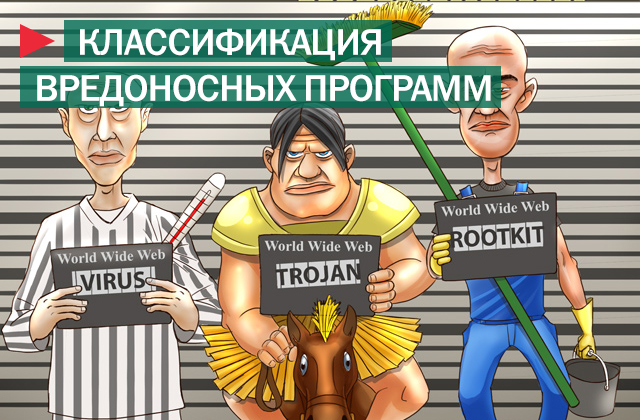
- Rootkits designed to hide other malicious software
By method of reproduction
This is software designed to pollute the OS, for example:
- So-called "Exploits," ordinary files that contain deliberately incorrect information, and therefore the program designed to open such files gives an error
- So-called "Logic bomb," triggers when a certain condition is met, may be tied to a useful program
Popular Antiviruses: